
Call / Whatsapp: +94 70 430 4307 Email: envigeotechnical@gmail.com
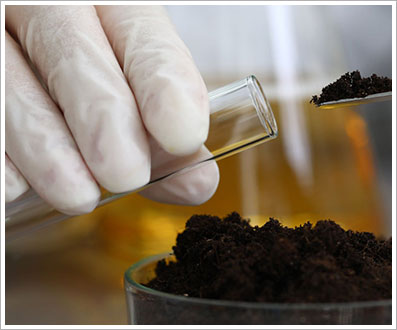
| Geotechnical investigations are performed by geotechnical engineers or engineering geologists to obtain information on the physical properties of soil earthworks and foundations for proposed structures and for repair of distress to earthworks and structures caused by subsurface conditions; this type of investigation is called a site investigation. Geotechnical investigations are also used to measure the thermal resistance of soils or backfill materials required for underground transmission lines, oil and gas pipelines, radioactive waste disposal, and solar thermal storage facilities. A geotechnical investigation will include surface exploration and subsurface exploration of a site. Sometimes, geophysical methods are used to obtain data about sites. Subsurface exploration usually involves soil sampling and laboratory tests of the soil samples retrieved. |
 |
Geotechnical investigations are very important before any structure can be built, ranging from a single house to a large warehouse, a multi-story building, and infrastructure projects like bridges, high-speed rail, and metros.
|
| Surface exploration can include geologic mapping, geophysical methods, and photogrammetry, or it can be as simple as a geotechnical professional walking around on the site to observe the physical conditions at the site. To obtain information about the soil conditions below the surface, some form of subsurface exploration is required. Methods of observing the soils below the surface, obtaining samples, and determining the physical properties of the soils and rocks include test pits, trenching (particularly for locating faults and slide planes), borings, and in situ tests. These can also be used to identify contamination in soils prior to development in order to avoid negative environmental impacts. |
| Soil sampling |
| A soil sample recovered from a test boring using a split spoon sampler.
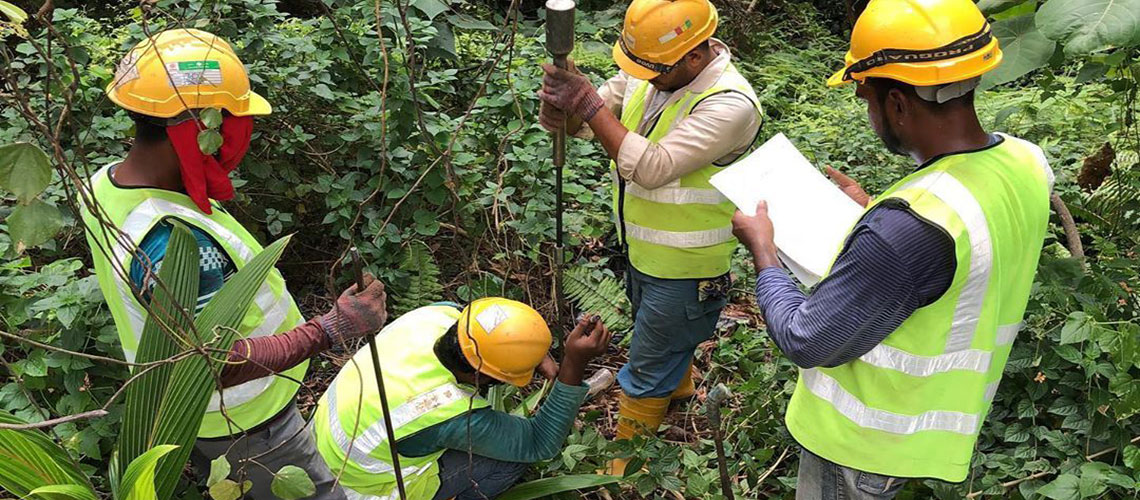
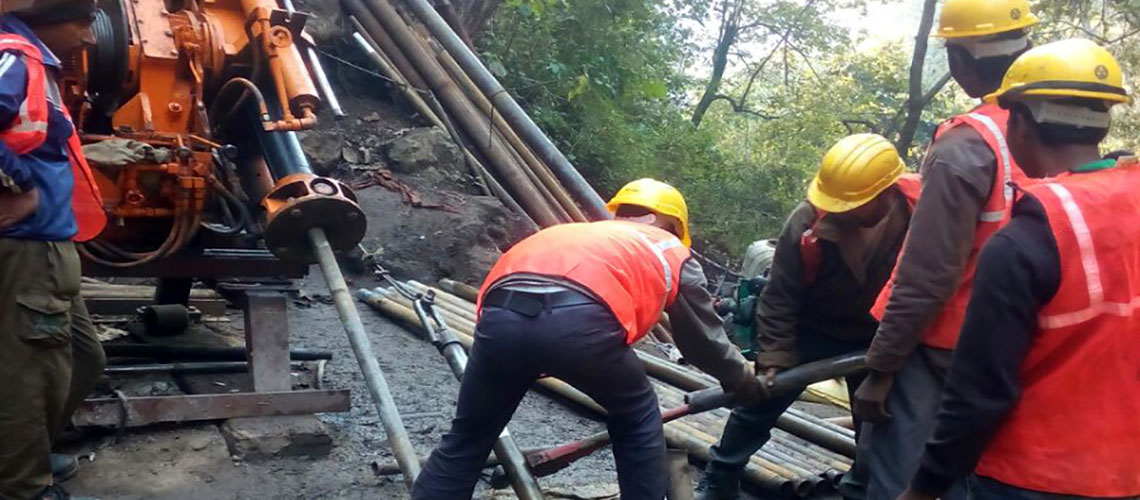
Borings come in two main varieties: large diameter and small diameter. Large-diameter borings are rarely used because of safety concerns and expense but are sometimes used to allow a geologist or an engineer to visually and manually examine the soil and rock stratigraphy in-situ. Small-diameter borings are frequently used to allow a geologist or engineer to examine soil or rock cuttings or to retrieve samples at depth using soil samplers, and to perform in-place soil tests. |
|
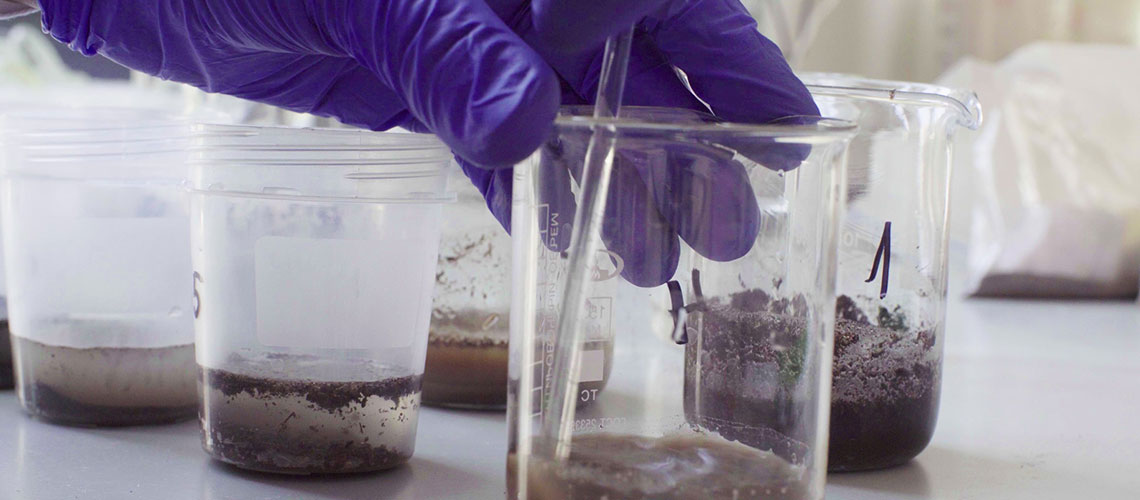
Soil samples are often categorized as being either disturbed or undisturbed; however, "undisturbed" samples are not truly undisturbed. A disturbed sample is one in which the structure of the soil has been changed sufficiently that tests of structural properties of the soil will not be representative of in-situ conditions, and only properties of the soil grains (e.g., grain size distribution, Atterberg limits, compaction characteristic of soil, to determine the general lithology of soil deposits and possibly the water content) can be accurately determined. An undisturbed sample is one where the condition of the soil in the sample is close enough to the conditions of the soil in-situ to allow tests of structural properties of the soil to be used to approximate the properties of the soil in-situ. Specimens obtained by undisturbed method are used to determine the soil stratification, permeability, density, consolidation and other engineering characteristics.
Offshore soil collection introduces many difficult variables. In shallow water, work can be done off a barge. In deeper water a ship will be required. Deepwater soil samplers are normally variants of Kullenberg-type samplers, a modification on a basic gravity corer using a piston. Seabed samplers are also available, which push the collection tube slowly into the soil.
In Situ Tests
:
» A standard penetration test is an in-situ dynamic penetration test designed to provide information on the properties of soil, while also collecting a disturbed soil sample for grain-size analysis and soil classification.
» A dynamic cone penetrometer test is an in situ test in which a weight is manually lifted and dropped on a cone which penetrates the ground. the number of mm per hit are recorded and this is used to estimate certain soil properties. This is a simple test method and usually needs backing up with lab data to get a good correlation.
» A cone penetration test (CPT) is performed using an instrumented probe with a conical tip, pushed into the soil hydraulically at a constant rate. A basic CPT instrument reports tip resistance and shear resistance along the cylindrical barrel. CPT data has been correlated to soil properties. Sometimes instruments other than the basic CPT probe are used, including:
» A piezocone penetrometer probe is advanced using the same equipment as a regular CPT probe, but the probe has an additional instrument which measures the groundwater pressure as the probe is advanced.
» A seismic piezocone penetrometer probe is advanced using the same equipment as a CPT or CPTu probe, but the probe is also equipped with either geophones or accelerometers to detect shear waves and/or pressure waves produced by a source at the surface.
» Full flow penetrometers (T-bar, ball, and plate) probes are used in extremely soft clay soils (such as sea-floor deposits) and are advanced in the same manner as the CPT. As their names imply, the T-bar is a cylindrical bar attached at right angles to the drill string forming what look likes a T, the ball is a large sphere, and the plate is flat circular plate. In soft clays, soil flows around the probe similar to a viscous fluid. The pressure due to overburden stress and pore water pressure is equal on all sides of the probes (unlike with CPT's), so no correction is necessary, reducing a source of error and increasing accuracy. Especially desired in soft soils due to the very low loads on the measuring sensors. Full flow probes can also be cycled up and down to measure remolded soil resistance. Ultimately the geotechnical professional can use the measured penetration resistance to estimate undrained and remolded shear strengths.
» Helical probe test soil exploration and compaction testing by the helical probe test (HPT) has become popular for providing a quick and accurate method of determining soil properties at relatively shallow depths. The HPT test is attractive for in-situ footing inspections because it is lightweight and can be conducted quickly by one person. During testing, the probe is driven to the desired depth and the torque required to turn the probe is used as a measure to determine the soil's characteristics. Preliminary ASTM testing has determined that the HPT method correlates well to standard penetration testing (SPT) and cone penetration testing (CPT) with empirical calibration.
» Electrical tomography can be used to survey soil and rock properties and existing underground infrastructure in construction projects.
A flat plate dilatometer test (DMT) is a flat plate probe often advanced using CPT rigs, but can also be advanced from conventional drill rigs. A diaphragm on the plate applies a lateral force to the soil materials and measures the strain induced for various levels of applied stress at the desired depth interval.
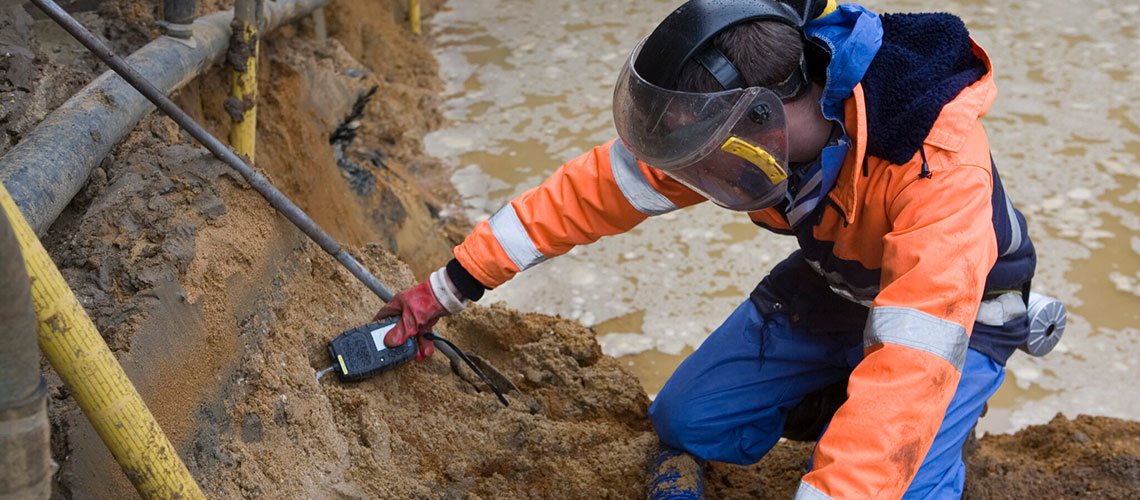
In-situ gas tests can be carried out in the boreholes on completion and in probe holes made in the sides of the trial pits as part of the site investigation. Testing is normally with a portable meter, which measures the methane content as its percentage volume in air. The corresponding oxygen and carbon dioxide concentrations are also measured. A more accurate method used to monitor over the longer term, consists of gas monitoring standpipes should be installed in boreholes. These typically comprise slotted uPVC pipework surrounded by single sized gravel. The top 0.5 m to 1.0 m of pipework is usually not slotted and is surrounded by bentonite pellets to seal the borehole. Valves are fitted and the installations protected by lockable stopcock covers normally fitted flush with the ground. Monitoring is again with a portable meter and is usually done on a fortnightly or monthly basis.
| "The dream, built on a perfect foundation: Sri Lanka's Best Geotechnical Solutions." |
|